The Mystery Walled Up at Ca' 'd la Mariòcia
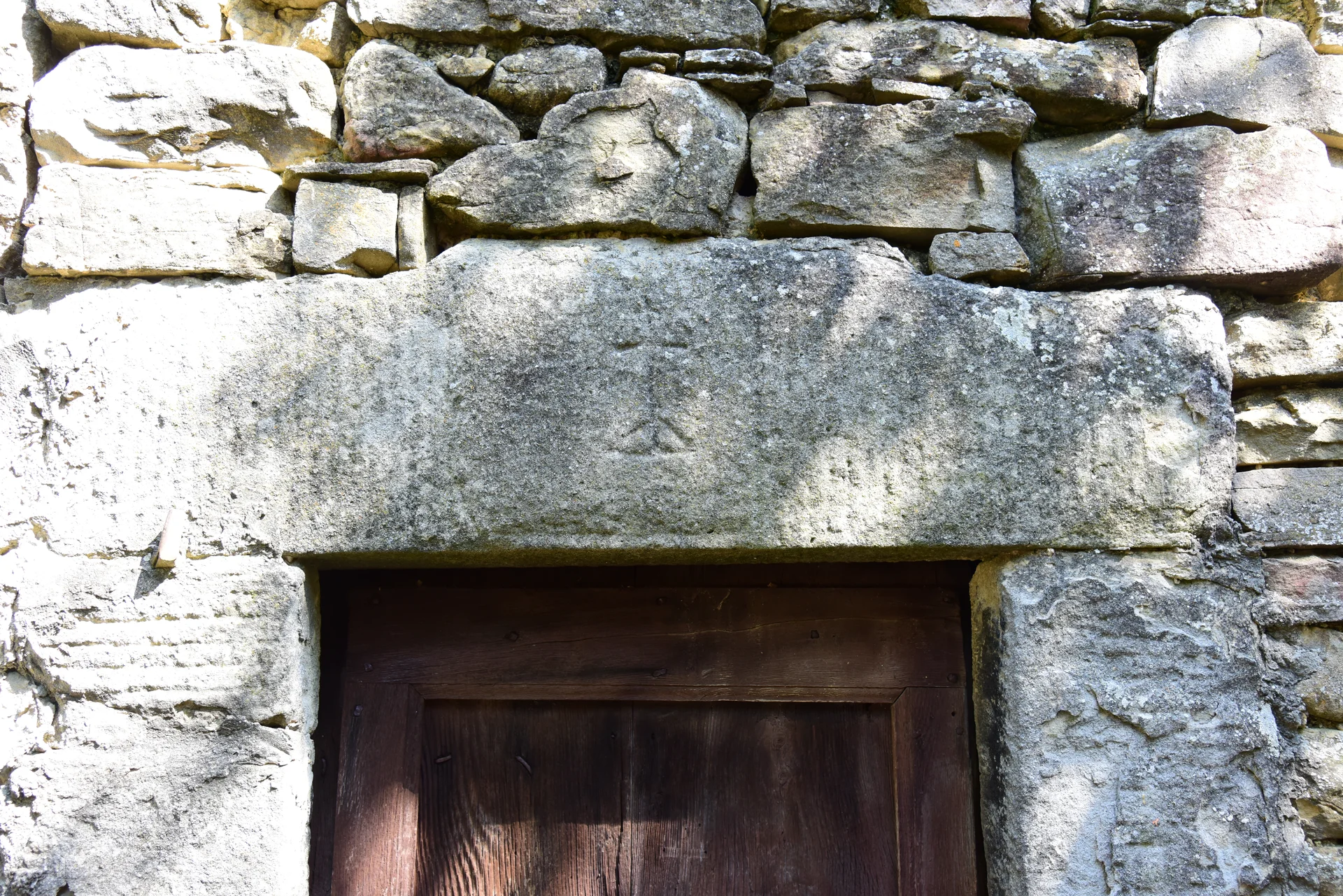
Hidden within the masonry of a 17th-century rural dwelling, three reused stones have guarded for centuries a secret that defies the oblivion of time. The discovery, made at Casa Ciocci, locally known as Ca' 'd la Mariòcia, is thanks to the sensitivity of Mirella Ciocci, who reported the finds to Ivan Tintorri, a passionate scholar of Apennine history. The subsequent analysis by Adolfo Zavaroni, a specialist in Italic epigraphy, revealed how these sandstone blocks are, in fact, silent witnesses to a forgotten cultural resistance.
We are on the route of the Via Romea Nonantolana. At this crossroads between Modena and Pistoia, the stones remained "hidden in plain sight" for centuries, guardians of a voice that does not belong to the builders of the house, but to the people who inhabited these peaks millennia before.
These vestiges are not mere ornaments, but the cries of a people who carved their vision of the infinite into stone.
The Friniates: An Indomitable People Among the Shadows of the Apennines
The Ligurian Friniates represent an extraordinary exception in the landscape of ancient Italy. Protected by the natural isolation of the Frignano valleys, they acted as an enclave of cultural resistance while the rest of the peninsula succumbed to Roman homogenization. For this people, the mountain was not only a physical barrier, but a spiritual shield that allowed the preservation of language and faith well beyond the fall of political borders.
Research indicates that, although some stones are datable between the 4th and 5th centuries AD, they reflect a cultural persistence of archaic origin. In an era when Christianity was establishing itself as a universal religion, the Friniates transformed their valleys into a bastion of identity, preserving a millenary system of beliefs. To survive in this new world, however, their communication had to become invisible, transforming into a unique system of signs inaccessible to the uninitiated.
Writing as a Rebus: The Cryptography of the Sacred
Ligurian writing is not a conventional alphabet, but a sophisticated "sacred game" based on ligatures. The signs do not follow one another in a straight line, but merge into each other, forcing the reader into an act of dynamic interpretation. As epigraphic studies emphasize:
"The writing system of the Ligurians changes according to figurative and symbolic intentions... the massive use of ligatures and the symbolic use of signs make writing a true cryptography, with ludic and, above all, religious purposes."
At Rocchetta Sandri, writing becomes a rebus: the circular composition of one of the stones allows overlapping and stratified readings, such as ruo, druo, buo, utiuu and uituu. This labyrinth of letters was not a mere aesthetic exercise, but a necessary protective measure. In a time of forced transition, cryptography became the sanctuary where the Ancient Gods were hidden, making the stone an impassable boundary between those who knew the code and those who saw only meaningless scratches.
The Great Clock of the Cosmos: Senior and Iunior
The Ligurian cosmos was conceived as a monumental rotating edifice, a mechanism of divine precision equipped with celestial gears that governed the motion of the sun and moon. At the top of this cosmic clock sat the senior god, the polyfunctional creator and ruler of the tripartite universe (heaven, earth, and the underworld), assisted in his task by the iunior god, the young luminous warrior and child of light.
Alongside this duality emerges the figure of Istios, the oracular god "of the people" and ancestor of the Ligurians, often represented in avian form or with a bird's head. The myth narrates an eternal cycle: at the autumn equinox, the iunior falls prisoner into the submerged world, taking with him the warmth of life. It is only in spring that the senior intervenes, symbolically beheading the sovereignty of death on earth and freeing the young servant. This cosmic resurrection was not only an astronomical event, but the necessary promise for the rebirth of every soul.
Signs of Light: From Mud to the Stars
Deciphering the stones of Rocchetta Sandri means immersing oneself in a sculpted prayer. The circular figure present in the finds is not just a geometric shape, but an allusion to the celestial vault and the journey of souls: the larger circle evokes the authority of the senior god, while the smaller inner one represents the iunior in his cycle of death and rebirth.
The architrave of Casa Ciocci instead presents a fake double cross, often confused with Christian symbols, which actually represents the "cosmic column" on which the sky rests, a fundamental attribute of the senior. In these inscriptions, the term ubutiou i emerges with overwhelming force: composed of ubutio (submerged world) and the affix u (outside), it concludes with the Ligurian imperative i, which means "Go!". The total message — "Out of the submerged world, go!" — is associated with the figure of a small bird with spread wings, symbol of the soul or psychopomp spirit that rises from darkness toward the light.
This invocation is closely linked to the term dusos, which identifies the spirit or soul understood as vital heat and animating force. In this context, every incision becomes a magical command, an exhortation so that the human spirit, like the child god, does not remain prisoner of the mud but rises toward the stars through the column that supports the universe.
The Legacy of the Stones: A Sculpted Hope
The value of the discovery at Rocchetta Sandri transcends the rigor of archaeology to touch the deepest chords of human experience. These stones are the testament of a cyclical vision of existence, a challenge thrown at death through the complexity of the symbol. In every "rebus" designed by the Friniates vibrates a hope that has never feared the passage of millennia: the idea that the end is only a phase of a larger mechanism.
Even today, observing the worn signs on the facade of Ca' 'd la Mariòcia, we can perceive the echo of that archaic voice which, stubbornly, continues to order life to break every chain and rise toward the sun.