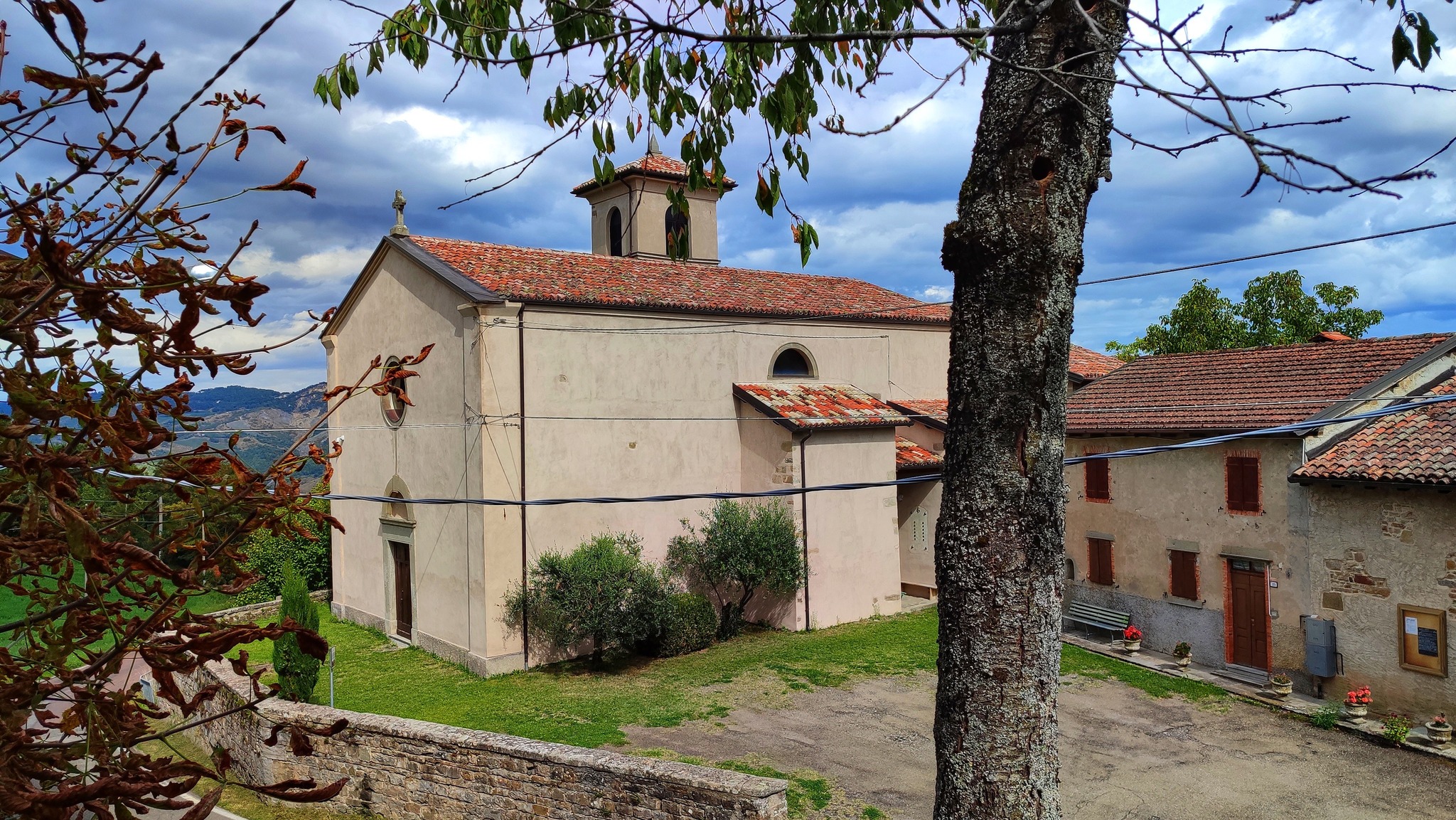
The Origins and Documentary Sources
The Parish Church of Rocchetta Sandri, dedicated to San Giovanni Battista (Saint John the Baptist) — patron saint of the village, celebrated on 24 June — has very ancient origins. A reference to it first appears in the Rationes Decimarum of the 13th century, from which we learn that it was a church dependent on the pieve of Fanano.
The church then appears in 1335 in a decision of the Sacra Rota and in 1363 in a collation of the rectorship of the Ospitale di Fanano made by the abbot of Nonantola. These documents testify to the spiritual and administrative importance of the place already in the Middle Ages.
The Architectural Complex
The parish church stands in an isolated position on the road leading up to the nearby cluster of Rocchetta. The attached buildings — the bell tower, the rectory, and a proper rural courtyard documented on the southern side of the church — form a unified building complex that characterizes the mid-slope landscape of Rocchetta Sandri, fragmented into building clusters of considerable size.
The Facade and the Renaissance Portal
The present building dates back to 1553, as attested by the date engraved on the side portal.
The facade is essential, with a wall framed by two slightly outlined corner pilasters, on which only the portal and the rose window stand out. The portal is decorated with Renaissance friezes, an element of refined craftsmanship that pleasantly contrasts with the sobriety of the whole.
"The simplicity of the facade does not prepare the visitor for the surprise of the interior, where the fifteenth-century spatial conception reveals itself in all its elegance."
The Interior: the Barrel Vault and the Chapels
The interior surprises with its spatial conception, in a fifteenth-century idiom. The plan consists of an elongated hall covered by a barrel vault punctuated by five arches, which gives the space a solemn and measured rhythm.
Opening off the hall are two side chapels set beneath the lunettes, which once housed two valuable paintings depicting Saint Stephen and Saint Anthony. Of notable interest is also the 18th-century piece of furniture in the sacristy, a testament to the refined quality of local craftsmanship.
The Wooden Baptistry and the Sculptural Elements
The left-hand altar is preceded, towards the entrance, by a smaller niche which houses one of the most precious pieces of the entire church: a wooden baptistry in the form of a small central-plan temple, clearly Bramante-inspired in conception.
This carved wooden work, with its central plan and harmonious proportions, represents a rare example of architectural sculpture applied to sacred furnishings in the Modenese Apennines.
Portal with Renaissance friezes
The side portal, dated 1553, is decorated with Renaissance friezes carved in local stone — the only ornamental element on an otherwise sober facade.
Barrel vault with five bays
The internal barrel-vaulted ceiling, punctuated by five transverse arches, recalls the architectural models of the Tuscan-Emilian Quattrocento.
Bramante-inspired wooden baptistry
A small central-plan temple carved in wood, in the style of Bramante: a unique piece in the Frignano area for its craftsmanship and spatial conception.
Sandstone stoup
The holy-water stoup by the side portal, carved in sandstone in the typical basin shape set into the wall, may date from the earlier church, before its destruction in 1535.
The Link with the Earlier Church
The present church, built in 1553, rises on the ruins of the primitive church, destroyed in 1535 on the orders of the ducal commissioner Zanelli as retaliation for the inhabitants' participation in the Sack of Sestola. Some elements of the present building may be recoveries from that medieval church already documented in the 13th century.
The holy-water stoup by the side portal — carved in sandstone in the typical basin shape set into the wall — is perhaps the most significant element of this continuity: a work that may date back to the primitive church and that was preserved in the Renaissance reconstruction, a tangible testimony of the link between the different historical phases of the building.
The church of 1553 thus represents not only a spiritual and material rebirth of the community of Rocchetta after the destruction, but also a bridge between the medieval past and the Renaissance, in which ancient elements coexisted with the new architecture.
← Back to What to Discover