The Cheese-Making Tradition of the Apennines
Mountain Parmigiano-Reggiano is the productive heart of the Modenese Apennines. In Rocchetta Sandri and the area around Sestola, the tradition of cheese-making has deep roots, linked to cattle farming and to the quality of milk produced in the mountain pastures.
The traditional economy of Rocchetta is based on producing high-quality milk. The cows reared in the Apennine stables yield milk rich in nutrients, ideal for cheese-making. This is no coincidence: the flora of the mountains, the clean air and the local culinary traditions have made mountain Parmigiano-Reggiano a product recognised throughout the world.
"Parmigiano-Reggiano is not just a cheese: it is the flavour of the mountain, condensed in every crystal, in every stage of maturing. It is the living testimony of the Modenese Apennines."
The Caseificio Santa Lucia: A Story of Tradition
In 1955, Mr. Negus together with his two cheese-making sons, Averado and Michele Cerfogli, opened a small private dairy that bought milk from the farmers of the Sestola area. The dairy was named Santa Lucia (Saint Lucy) as a sign of good omen: it was, in fact, peasant tradition to entrust oneself to the saints for good fortune.
In 1962 the dairy became an agricultural cooperative bringing together the many small farmers working in the area. In the 1970s the founding members split, forming two cooperatives. Thus was born the Santa Eurosia cooperative (also known as the New Dairy) in honour of the patron saint of the small village, while the Caseificio Santa Lucia remained unchanged in name and location. Together they counted more than 100 members.
Over the years the contributing members decreased, until in the 1980s the two cooperatives merged once again under a single dairy: Santa Lucia, which continues today to produce D.O.P. Parmigiano-Reggiano.
The Production Process
Every day the freshly milked morning milk arrives at the dairy directly from the stables. This process is followed with precision, according to the historical rules of Emilian cheese-making.
Milk collection and heating
The freshly drawn morning milk is poured into copper cauldrons, together with the evening milk, the whey obtained from the previous day's work, and the rennet.
Cooking and extraction
Once cooked and extracted, the skilled hands of the master cheese-maker shape the Parmigiano Reggiano, creating the characteristic form of the cheese.
Moulding and marking
The obtained wheel is cut and wrapped in cloth. It is then placed in a mould that gives it the typical cylindrical shape. At this point, a casein plate is applied to identify the wheel.
Immersion and resting
After immersion in a solution of water and salt, the wheel may rest in the warehouse awaiting the official D.O.P. marking.
Maturing
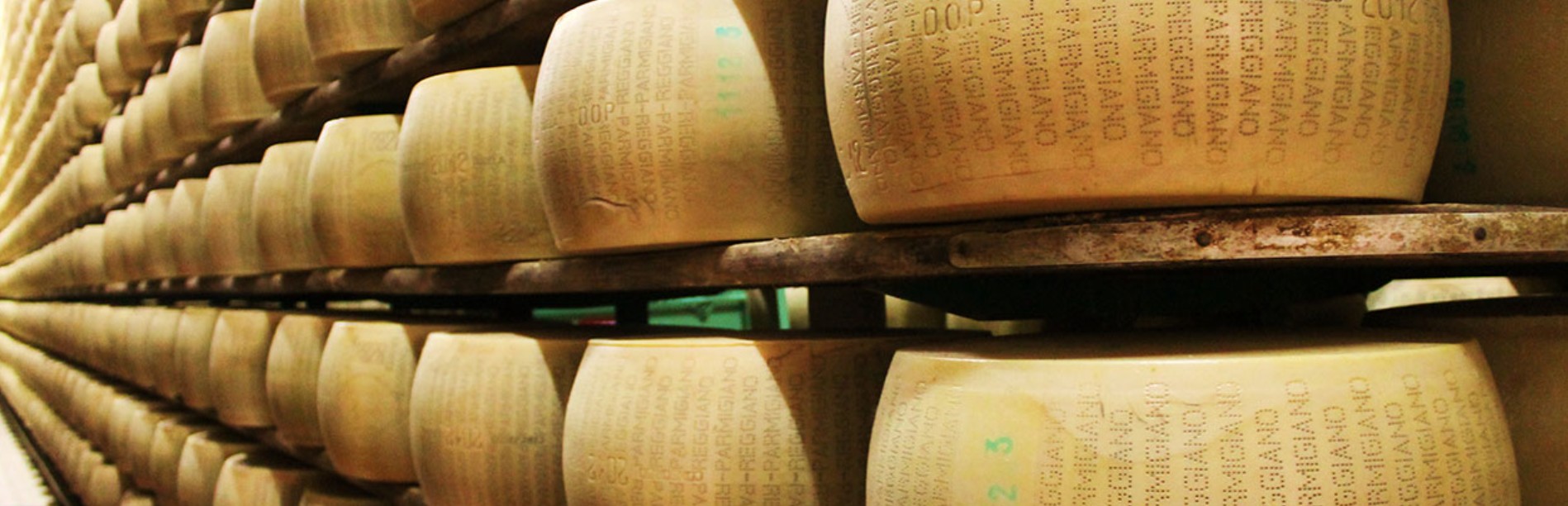
The wheels of Parmigiano Reggiano remain in the warehouse for a minimum of 12 months. Maturing is essential to acquire the organoleptic characteristics that distinguish the product.
Quality and Recognition
The Parmigiano-Reggiano produced at the Caseificio Santa Lucia is D.O.P. (Protected Designation of Origin), which means its production is subject to strict controls and production regulations. Only cheese meeting specific characteristics can receive the official mark.
The quality of mountain Parmigiano-Reggiano is recognised for its unique organoleptic properties: a complex flavour, with notes of hazelnut and caramel, a well-developed crystalline structure, and a persistence of flavour that distinguishes it from other cheeses. It is the result of a long tradition, of the quality of mountain milk, and of the experience handed down through generations of cheese-makers.
← Back to What to Discover