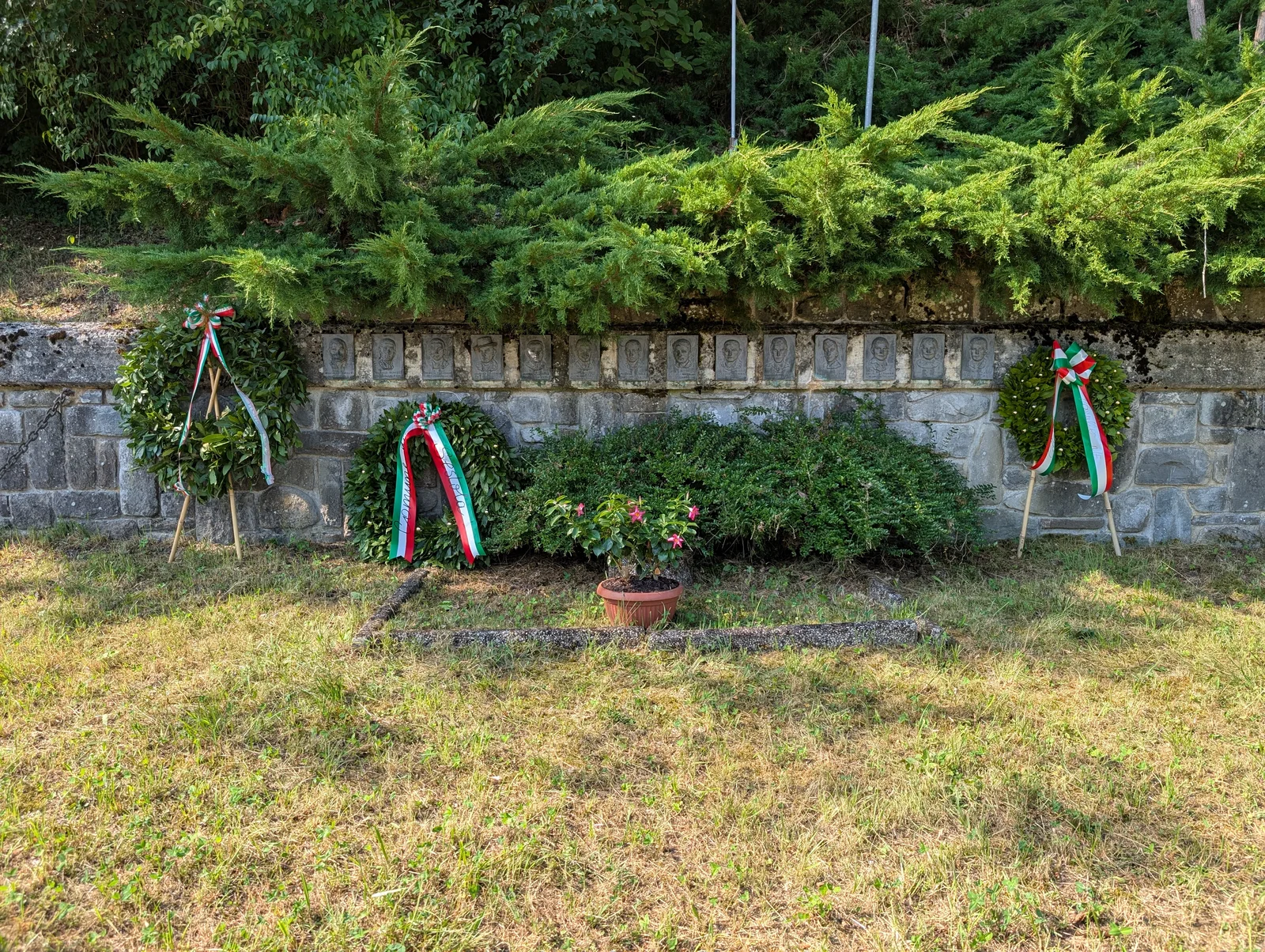
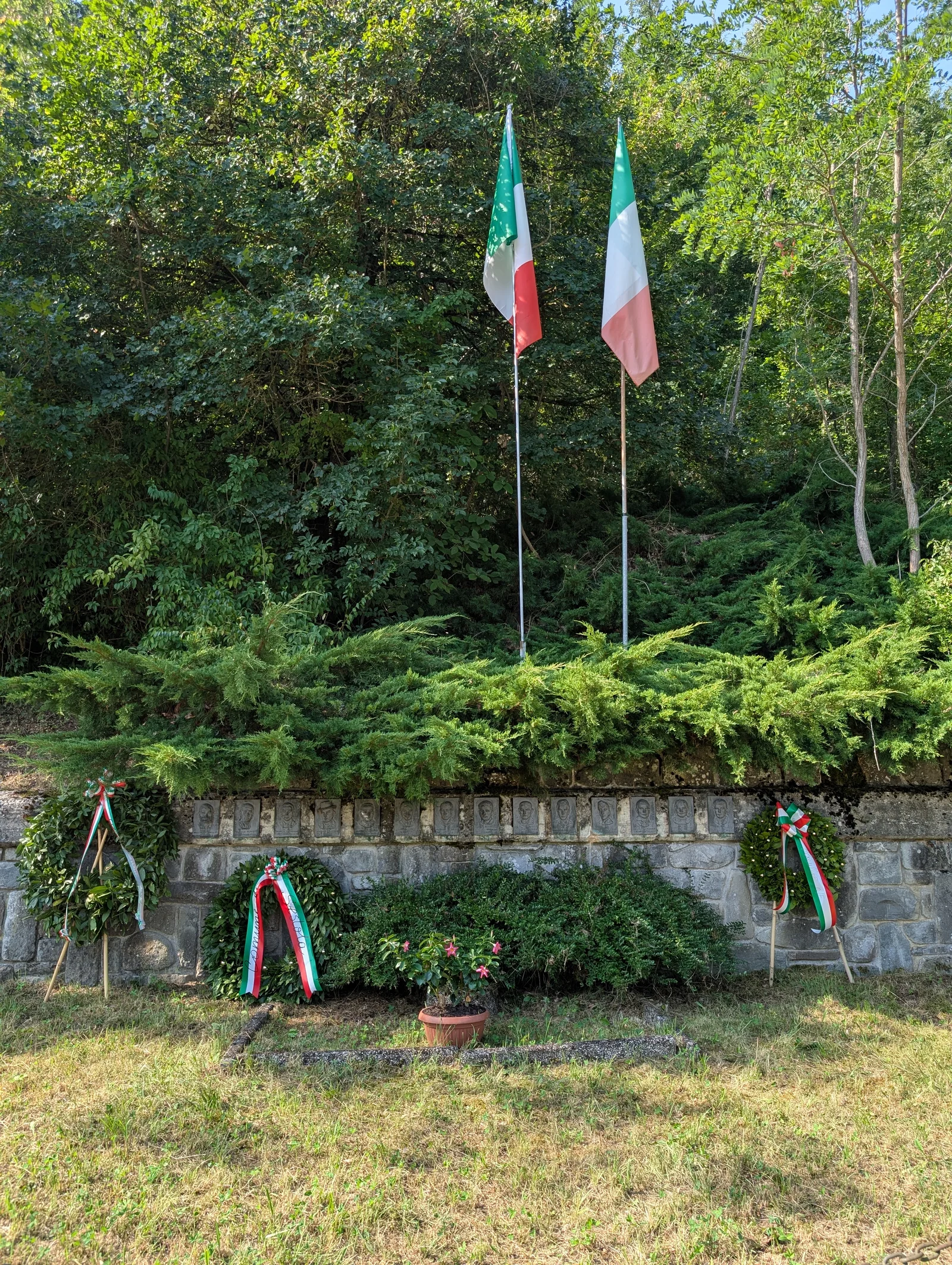
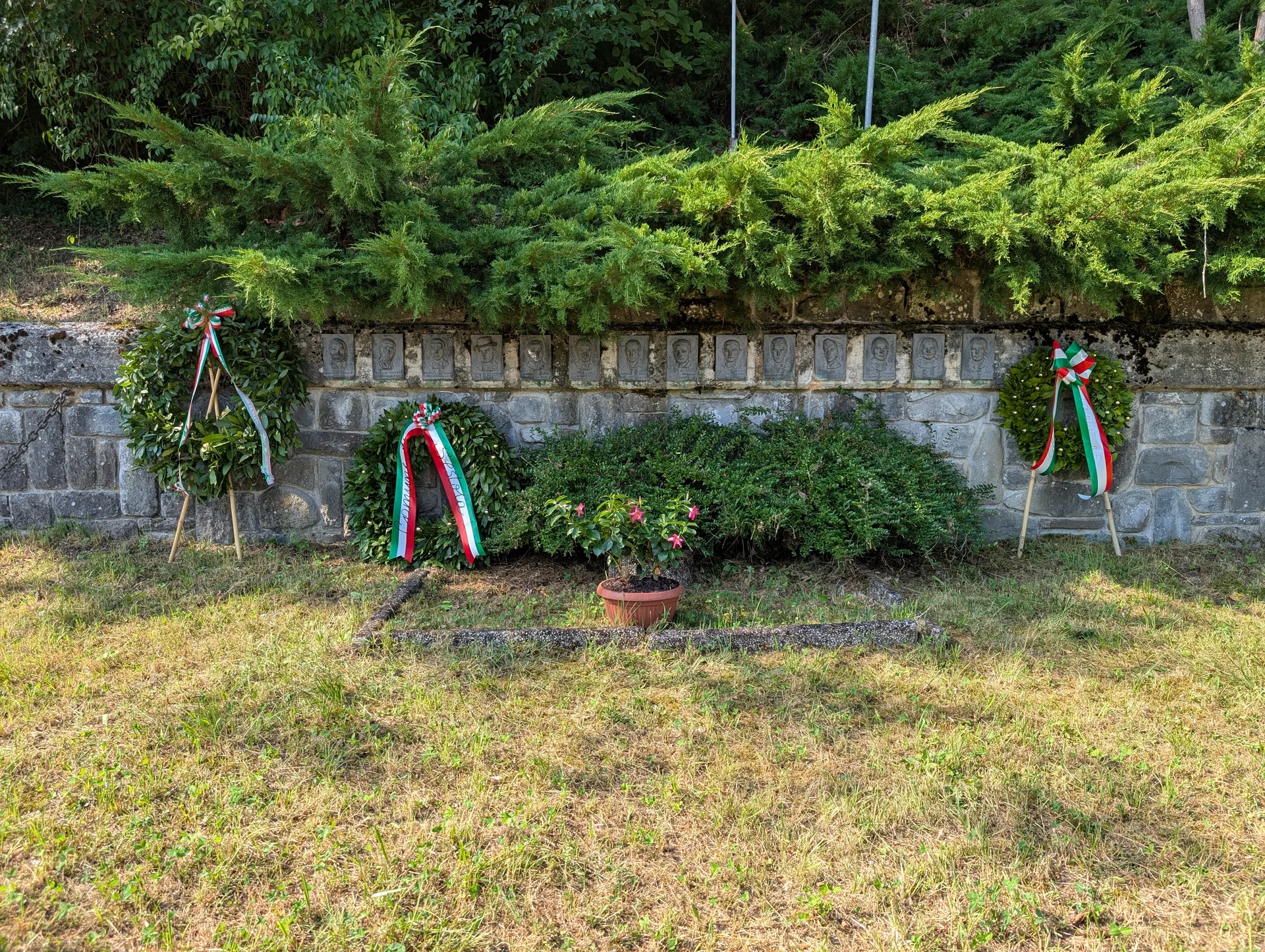
Monument to the fallen partisans in Rocchetta Sandri
Important moments

The tragedy of Rocchetta in flames

August 1944 – The Nazi-Fascist roundup and the sacrifice of 14 partisans

These documents reconstruct the dramatic events that took place in Rocchetta Sandri in August 1944, when Nazi-Fascist troops unleashed a violent wave of repression and roundups in the Modenese Apennines.

The testimonies describe the end of the Republic of Montefiorino and the sacrifice of the partisans of the Modena Division, decimated during the dangerous crossing of the Scoltenna river. Personal accounts and poems highlight the terror of the civilian population, forced to endure reprisals, arson and deportations that destroyed entire homes and family ties.

In addition to the chronicle of the fighting, the collective memory of a community that has transformed pain into historical commemoration emerges, honouring the fallen through monuments and local celebrations. The material thus offers a choral look that combines the rigour of historical reconstruction with the emotionality of childhood memories and popular poetry.

The context

11 August 1944

After the Republic of Montefiorino

After the attack on the free zone of Montefiorino launched at the end of July, the German armed forces threatened the entire Panaro river valley, which begins near Rocchetta Sandri, where the Leo and Scoltenna streams converge. In those days, Leandro Palmieri's partisan battalion reorganised in the shelters of Rocchetta Sandri, largely made up of boys from Castello di Serravalle, born and raised on the Bolognese hills.

The German Operation "Belvedere"

On 11 August 1944, imposing Nazi-Fascist forces surrounded the "A. Corsini" Brigade which was resting in Rocchetta Sandri. The German units, assisted by the GNR, having learned of the partisans' movement, crossed the Scoltenna river and attacked them: it was the beginning of the "Belvedere" roundup operation.

The victims

In the ensuing combat 14 partisans fell: Riziero Agostini, Dario Baldini, Oliviero Ballanti, Vittorina Bedonni, Danilo Battelli, Franco Bolelli, Senesio Cerchiari, Mario Daccomi, Enrico Mazzoni, Seminio Palmieri, Osvaldo Piccioli, Renzo Piccioli, Fernando Predieri, Mario Zoboli. In the battle 11 partisans were killed, of which 8 fell in the ambush at the Mulino del Leo while crossing the river, and 3 more partisans plus 3 civilians were captured and executed. Some houses were set on fire.

The legacy

After the "adventurous salvation" of 11 August 1944, Leandro Palmieri and Loris Degli Esposti dedicated the battalion to the partisan Sissinio Palmieri, and in the winter between 1944 and 1945 the boys of the Castellettese group crossed the front of the Gothic Line and continued the fight alongside the Anglo-Americans, keeping alive the memory of their companions.

A commemorative monument still stands today near the bridge of the Scoltenna stream in Rocchetta Sandri, remembering this battle which represents one of the bloodiest episodes of the Resistance in that area of the Modenese Apennines.

A witness

When the Germans arrived

Liberata Bernardini, 15 years old, Cerro di Rocchetta Sandri

I remember the morning of 12 August 1944, I was a 15-year-old girl, and like every morning, after taking the cows to pasture, I went to the 8.00 Mass. When I arrived at the church, the priest's father informed us that the Germans had arrived in the locality "Casa della Marianina".

The news terrified us, because "Al Cerro" where I lived and still live, the partisan formation of Tommaso Ferrari composed of about 30 partisans had been camped for a week, they slept in our "teggia" some were locals, others came "from away", from far away, even from Bologna; they had arrived from Montefiorino following the famous battle.

I, Laura Santelli and Gina Santelli ran, in a panic, home to warn. The partisans already knew the news, some ran away and others hid in the nearby bushes. I remember that 2 women followed the formation (killed a few days later, in the locality "Gallinaro"), and that weapons, an Italian flag and some clothes were thrown into the "Ghigliottina" (deep crevice in the rock) to erase the traces of their presence.

With wide and incredulous childish eyes I began to hear mortar shots and bullets falling next to me. They were also shooting from Gaiato. All the men of the families ran to hide in a shelter dug some time before underground in the "Campo delle mele" to avoid being arrested and deported, only women and children remained.

After the attack the German troops arrived, they ordered us to cook 15 chickens, otherwise they would have killed us all, I think our animals perceived the fear, because the chickens were all crouched down and let themselves be caught without any difficulty. On that tragic day Evaristo Passini was arrested and deported. The German formation camped at Il Cerro.

During the night, to feel safer, all the women and children slept together and we heard shots and screams, we were horrified. In the early morning the Germans took some of our haystacks and burned, in retaliation, some houses of Cerro. My mother, for fear of losing everything, threw what she could out of the window, I remember a bucket that rolled for a long time down the slope below. Everything burned, they also stole an ox and left.

The return of the Germans

The truce lasted little. Around 15 August they returned, it was a terrible day in the history of Rocchetta, so many houses were burned: Casa Battistella, Il Casino, Poggioluccio, Il Poggio, La Teggia, Il Corneto, Casa Ciocci was spared thanks to the intervention of the priest Don Boni, and others that I don't remember.

Other memories

At night we had to keep all the lights off because "Pippo" passed, with this funny name we referred to a reconnaissance plane (probably American) that signalled where to bomb, usually where there were lights. In the long nights of that winter of 1944/45 very often the Germans burst into our houses, all dressed in white to camouflage themselves in the snow.

In all this horror, I remember a gentle act of compassion, my father sick came down the stairs without knowing there were unexpected guests, he was not arrested, they instead took an interest in his health. During one of these nightly raids, Giuseppe Santelli jumped from a window over 5 metres high, he fell, got up and like a flash I saw him disappear into the snow.

In January 1945 we were warned that the front would pass from Cerro, the Germans had placed their artillery in the "Campo della Chiesa" a few metres from our house. We were forced to "evacuate", we had hidden in a "Fondo", then walled up the few things we had. Cerro was bombed, many houses destroyed, when we returned to our house the floors were missing, the wood had been used to build a shelter, I went to see it, it was beautiful, I remember it smelled good.

In this period even the wheat got sick, it got "morella", the ears turned black and could not be used. The little wheat that was not diseased did not grow enough and so did the grass... who knows...

Finally we heard the festive bells announcing the end of the war, it was 25 April 1945.
Another memory

The roundup in the memories of Eugenio Passini

Told by his son Walter Passini

At Cerro, while the rumble of the steam thresher filled the air, Eugenio Passini and his partner Vito — called "Vito ad Malcambi" — were busy with their work. Eugenio was the first to hear the alarm: the SS were coming. It was chaos. Everyone fled, everyone except Vito, who, confident in his threshing permit issued by the local authorities, stood still, awaiting the inevitable arrival of the Germans to show the permit.

At the same time, the drama was unfolding on another front. Gino Passini, Bruno's father, and his brother Evaristo were seized with anguish: their cousin Maria, a girl of only fifteen, had taken the family cows to pasture and was not returning. Driven by desperation, the two men launched into a frantic search to find her, unaware of the impending danger.

For all three there was no alternative: the Germans captured Vito, Gino and Evaristo without mercy. All three were taken to Fossoli, the macabre collection centre on the Brenner railway line. From there, destinies diverged tragically: Vito disappeared into the darkness of Fossoli, while Gino and Evaristo were deported to Germany as slave labourers. Only they, miraculously, returned when the war ended and they were liberated.

The poem of the storyteller

The story of the fire

Emilio Garofoletti, extemporaneous poet

Trent'anni or già son passati
dalla triste guerra mondiale,
nel quarantun ancor più micidiale
altra guerra ci porta terror.
Se vi piace conoscer l'avverso
alla scritta porgete attenzione,
lagrimar farà tante persone
che in petto gli palpita un cor.

Il sedici e ventidue d'agosto
quando il sole festeggia il leone,
fu strage e fatal distruzione
che spavento destava a veder.
La Rocchetta invasa dal fuoco
sotto pioggia di fitta mitraglia,
Belvedere subiva battaglia,
a Rocchetta si piangeva in dolor.

D'improvviso sentii una voce:
andiamo, già urge fuggire,
il nemico s'affretta a venire
lo Scoltenna si provi a passar.
Come pesci guizzammo nell'acqua
insieme gettandoci a nuoto,
molti getti di ferro e di fuoco
da ogni parte salivan nel ciel.

Un reparto di partigiani
provenienti da Sassoguidano,
fieri col mitra alla mano
s'adopravan il fiume a passar.
Non ancora alla sponda di fronte
di Gaiato la brulla pendice,
tatata la mitragliatrice
con cruda voce li chiama a morir.

Agonizzanti nel letto di ghiaia
senza niuno a dargli conforto
qualcuno in breve fu morto
i lor cari non vider mai più.
Noi fuggiaschi nascosti nel bosco
tremanti e col cuore oppresso,
conoscenti mi stavan d'appresso
lagrimando i suoi figli nel duol.

Innocenti sperduti e sbandati,
l'orrore del ferro e del fuoco,
un'inferno parea quel loco
spaventoso incuteva terror.
Ovunque crollate le case,
incendi che parean vulcani
i tedeschi con certi italiani
gioivan di tanto orror.

Acute grida disperati lamenti
in frazione Trentino e Rocchetta,
gli abitanti tutti alla stretta
per poter alla morte sfuggire.
Divise e sperdute le care famiglie
genitori fratelli e sorelle,
sbandate le madri anche quelle
i congiunti non vider mai più.

Chi pensava dolente e piangendo
al figliolo soldato lontano,
altri piangean il partigiano
già pensando vederlo mai più.
Terrorizzata una povera sposa,
vedendo il marito schiacciato
sotto un muro, che ivi crollato,
demolito dal rogo infernal.

Con tre figli d'intorno piangenti
adolescenti si tenean per mano,
Arnaldo Ledèrico ognun partigiano
il lor padre piangendo nel ciel.
Un'altro padre versava in pianto
i suoi figli di fronte vedendo,
dal dolore parlar non potendo
udiva i figli chiamare papà.

Uno andava e l'altro veniva
per impervio ignoto sentiero,
con lo sguardo fissando il vero
il racconto qui in breve vi fò.
E dò fine al fato dolente
alla mente vo dare riposo,
di Fanano e di Ronchidoro
parlar ancora io vi potrò.

Un augurio alle vostre famiglie
che non vi colga funesta la morte
nelle vostre case sorrida la sorte
ed un giorno la gloria del ciel.

EMILIO GAROFOLETTI
poeta estemporaneo

Audio and images

Listen and watch

🎙️

The tragedy of Rocchetta

Podcast on the Nazi-Fascist roundup
📜

Rocchetta in flames

Garofoletti's poem becomes a song